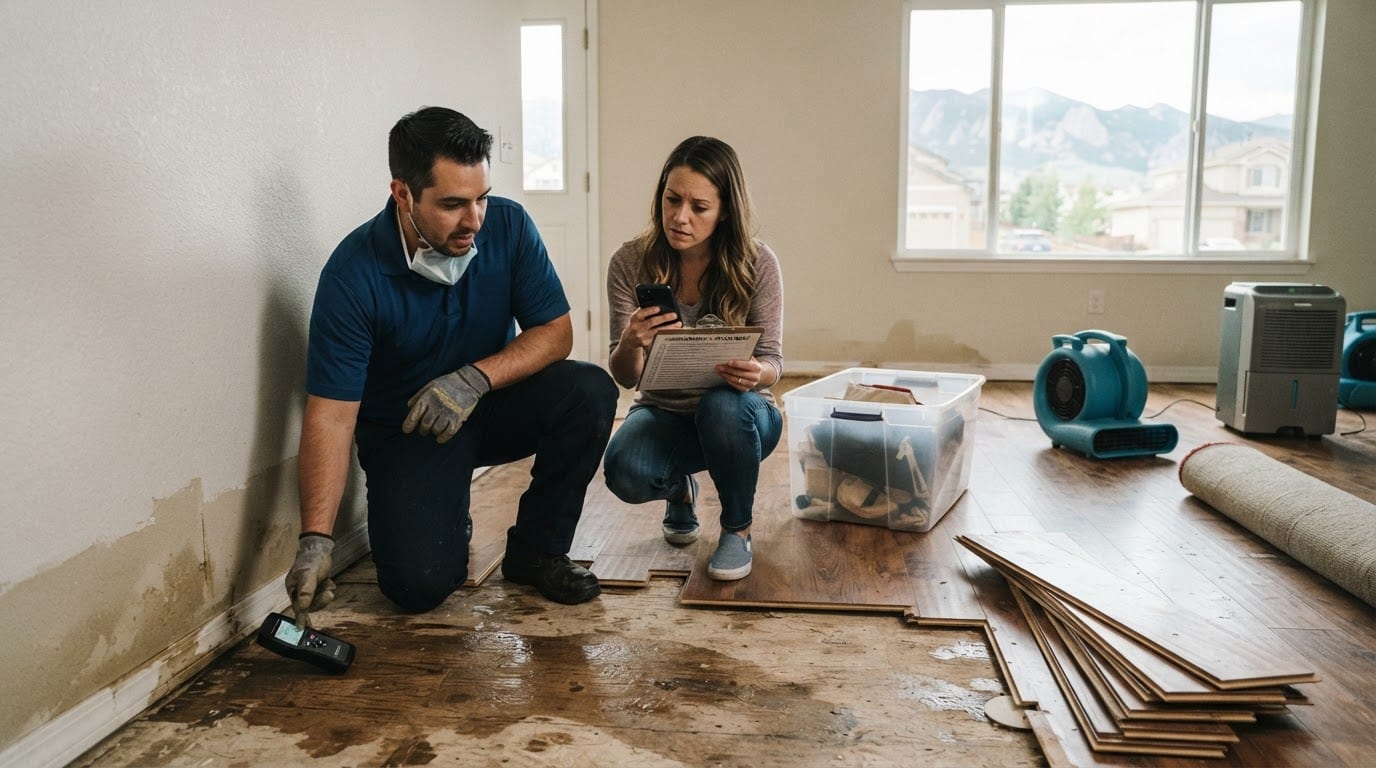
The first 24 to 48 hours after a water event often decide how much of a house survives. Water that looks like a manageable puddle can wick into drywall, saturate insulation, and settle under flooring before anyone sees the stain. Homeowners and property managers who understand the sequence of cleanup, from shutoff through documentation, drying, and rebuilding, make better decisions under pressure and avoid costly mistakes.
Residents looking for Water Damage Cleanup Centennial often discover that the process involves more than pumping out a basement. It requires classifying the water, assessing structural risk, mapping moisture, and coordinating with an insurer. Each step shapes the next, so skipping one can add days of drying time and thousands of dollars in avoidable replacement work.
Water events rarely wait for a convenient time, and the response team’s performance depends on what the property owner does first. Shutting off the source, documenting the damage, and keeping the affected area ventilated all matter before a technician arrives. For households that need a structured plan, Restoration Logistics Centennial offers a working reference for how emergency mitigation typically moves from assessment to final drying verification.
Securing the Property and Documenting Losses Before Cleanup Begins
Safety comes first. If water has reached outlets, switch boxes, or appliances, shut off the main electrical breaker only if you can reach it without standing in water. If the water is near the panel or you are unsure, call the utility provider or an electrician and keep people away from the area. Water conducts electricity, and wet wiring can energize metal fixtures without visible warning.
Next, stop the flow. Close the main water valve, typically located where the supply line enters the home. Shutting off a single fixture valve helps only if the failure is isolated to that fixture. If a water heater or washing machine is the source, turn off its dedicated supply.
Watch for structural warning signs. Sagging ceilings, bowed walls, cracked drywall that wasn’t there before, and floors that feel spongy or shift underfoot all indicate that water has compromised load-bearing or sheathing materials. Leave the building if ceiling water is bulging, and do not enter a basement if the stairs or foundation look unstable.
Documentation protects the claim. Before anything is moved or discarded, photograph and video-record every affected area, including the water line on walls, the source of the leak, and damaged contents. Create a written inventory with item descriptions, approximate ages, purchase prices where known, and serial numbers for electronics. Keep damaged materials until the adjuster has seen them. Early records support the scope of work and reduce disputes later.
Homeowners can safely handle some tasks alone: moving furniture and electronics out of the water, placing towels, running dehumidifiers that are already on site, and opening windows if weather permits. Professional help is necessary for standing water beyond a few inches, any contact with sewage, electrical concerns, mold visible beyond small patches, or any situation where wet materials cannot be fully dried within 48 hours. Mitigation companies generally follow the ANSI/IICRC S500 standard, and certified technicians often hold the IICRC Water Damage Restoration Technician (WRT) credential.
How Water Category and Drying Class Shape the Cleanup Plan
The IICRC classifies water into three categories based on contamination. Category 1 (clean water) comes from sanitary sources, such as a broken supply line or a failed toilet tank with no contaminants. Category 2 (gray water) contains significant contamination and may include washing machine overflow or dishwasher discharge. Category 3 (black water) is grossly contaminated, including sewage backups, rising floodwater from rivers or storm surges, and water that has sat long enough for microbial growth to become a concern.
Category determines what can be saved. Clean water losses often allow wood framing, carpet, and some cabinetry to be dried in place. Gray water generally requires removal of porous materials such as carpet pad and some drywall. Black water usually calls for removal of nearly all porous building materials, including drywall, insulation, and carpet, with antimicrobial treatment of structural surfaces. Water can migrate from a lower category to a higher one over time, so a clean supply-line break left for several days may need to be treated more aggressively.
Drying class reflects how much moisture the water has introduced and how difficult it will be to remove. The IICRC defines four classes, ranging from Class 1 (limited absorption, such as a wet baseboard) to Class 4 (specialty drying, typically for materials such as hardwood, plaster, or concrete with deep moisture pockets). Two floods that look similar on the surface can require very different work. A few inches of water on a tiled kitchen floor may be Class 1 or 2, while the same depth on a hardwood floor that has absorbed water into the subfloor and wall cavities may land in Class 3 or 4, requiring more specialized equipment and longer drying times.
Local Water Scenarios Centennial Homes Commonly Face
Centennial sits in Arapahoe County on the Colorado Front Range, where the climate creates predictable water risks. Spring snowmelt and intense summer thunderstorms can overwhelm storm drainage in lower-lying neighborhoods near Cherry Creek and Big Dry Creek corridors. Basements and crawl spaces take the brunt of these events, especially when sump pumps fail during power outages or when window wells fill faster than their drains can handle. Sump pump failure is the most common cause of basement water losses in the area, and a battery backup or water-powered backup system can prevent it.
Freezing temperatures create a second set of problems. Pipes running through unheated garages, crawl spaces, or exterior walls can split during cold snaps, and water heaters in unconditioned spaces are prone to tank failure and leakage. Because freeze-related breaks often go unnoticed while occupants are away, they can release large volumes of water before discovery.
Hail and heavy precipitation also drive roof and attic losses. Hail can crack shingles or puncture underlayment without leaving obvious interior evidence, and water tends to follow framing members and insulation before reaching a ceiling.
Older homes add complications. Galvanized or polybutylene supply lines are more prone to failure, and aging sewer laterals can intrude into the building through floor drains during heavy rains. Each scenario changes the cleanup approach: a sewer backup is a Category 3 loss requiring full removal of contaminated materials, while a supply-line break may be Category 1 if addressed quickly.
Why Water Travels Differently Than Homeowners Expect
Water rarely stays where it lands. It runs along the top plate of a wall, down the cavity behind drywall, and under baseboards, sometimes several feet from the visible stain. Capillary action draws moisture into wallboard and wood, and water can pool beneath vinyl plank or carpet where the subfloor absorbs it like a sponge. Insulation, particularly fiberglass batts, holds moisture and slows drying, and wet insulation can keep wall cavities damp for weeks. Visible damage therefore understates the problem. A small stain on a ceiling may hide a wet wall cavity, a saturated subfloor, and a mold risk that will not appear until later.
Drying, Moisture Monitoring, and Knowing When to Remove Materials
Drying begins with a moisture map. Technicians use a pin-type or pinless moisture meter, along with thermal imaging cameras, to identify wet areas and establish baseline readings on unaffected materials. These readings are recorded on a drying log, often using software tied to the IICRC S500 framework, and reviewed daily until the building reaches dry standard.
Equipment placement follows the water pattern. Air movers, typically high-velocity axial fans, are positioned to create airflow across wet surfaces, including wall cavities and floor-level spaces. Dehumidifiers, including low-grain refrigerant units and desiccant systems in cold conditions, reduce humidity in the air to encourage evaporation. Technicians may drill small holes or remove baseboards to place air movers into wall cavities and use injection drying systems in plaster walls.
Materials are typically removed when they cannot be dried effectively within the drying window. Drywall that has been wicked above about 12 inches or contaminated by Category 2 or 3 water is usually cut out. Insulation that is saturated is generally removed and replaced. Carpet pad is nearly always discarded, and carpet may be salvaged depending on the water category. Hardwood and engineered flooring are often dried in place, but laminate and particleboard swell and typically require replacement.
Mold growth can begin within 24 to 48 hours in warm, humid conditions, and visible colonies may appear within 7 to 14 days. Delayed drying increases the likelihood that a manageable loss becomes a remediation project. The EPA recommends drying wet materials quickly and cleaning or removing water-damaged materials within that window to limit mold growth.
Typical drying takes three to five days for a moderate residential loss, though complex losses in basements or structures with deep wall cavities can run longer. The job is finished when the affected materials match unaffected reference readings, when the drying log shows stable numbers across consecutive readings, and when equipment is removed by the technician. Homeowners should expect the building to smell less musty, surfaces to feel dry, and reference readings to return to normal ranges.
Cost is closely tied to scope. Water mitigation for residential losses often falls between about $2 and $7 per square foot, depending on category, class, and the extent of material removal. Basement losses with black water can cost substantially more.
Insurance Timelines, Scope Disagreements, and Preventing a Repeat Loss
A typical claim begins with prompt notice to the insurer, ideally within 24 to 48 hours. The carrier assigns a claim number and may send an adjuster within days, depending on workload and the size of the loss. The adjuster inspects the damage, reviews the mitigation company’s moisture logs and photos, and prepares an estimate. Final scope approval may take one to several weeks, and supplements are common as hidden damage emerges during demolition.
Disagreements often center on repair versus replacement. Adjusters may propose cleaning baseboards or cabinets, while the homeowner or contractor argues that exposure to Category 2 or 3 water requires replacement. Documentation resolves most of these disputes: moisture logs showing which materials failed to reach dry standard, photographs of water lines, sampling results where applicable, and manufacturer guidance for affected products. Homeowners should also clarify whether policies pay actual cash value or replacement cost, since depreciation can reduce the initial payment.
Prevention is cheaper than recovery. Low-cost measures include:
- Battery backup or water-powered backup for sump pumps, typically $300 to $800 installed
- Water leak sensors placed near water heaters, washing machines, and under sinks, often $20 to $50 each
- Smart shutoff valves for the main supply line, commonly $300 to $700 installed
- Accessible shutoff valves with clear labeling, which cost little but save critical minutes
- Seasonal checks on appliance hoses, water heater anode rods, and roof flashing
- Clearing window wells, downspouts, and grading that slopes away from the foundation before spring
Insulating exposed pipes in unheated spaces and keeping thermostats above freezing when away also reduce the risk of freeze-related breaks.
